Overview
FFMVic’s role is to reduce bushfire risk to communities, critical infrastructure and the environment.
This work includes the reduction of risk following large storm events that impact public land.
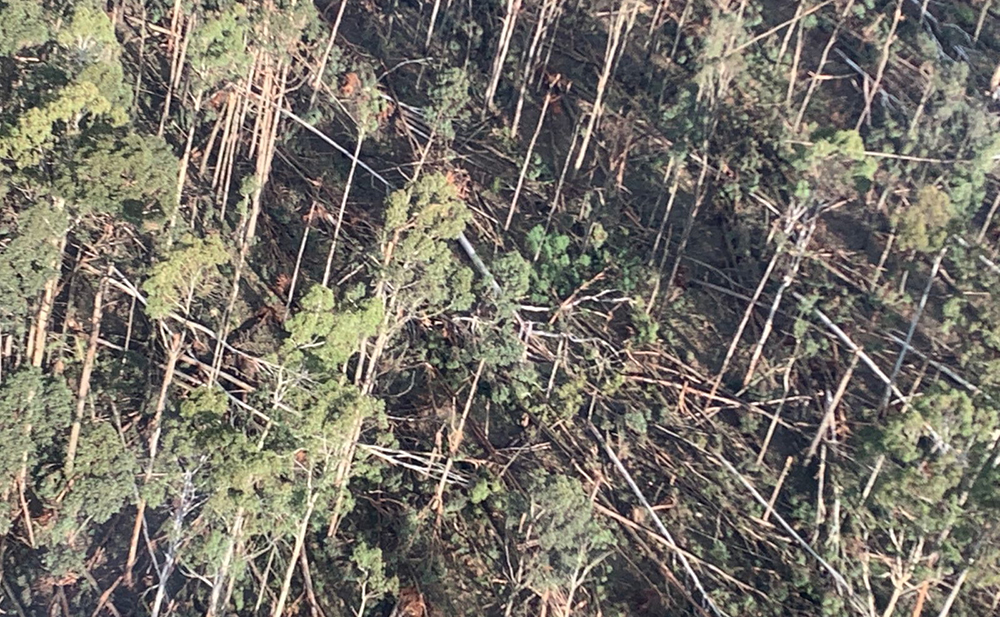
Severe storms impacted parts of Victoria in and around the Wombat Forest and the Dandenong Ranges during the winter and spring of 2021. Since then, FFMVic has had a program in place to carefully remove storm debris to reduce fire risk and rehabilitate these forested areas.
This work was necessary as the storms resulted in hazardous trees and debris across about 2,000 hectares of public land that increased bushfire risk and blocked safe access for firefighters.
Furthermore, a storm in 2024 around Mirboo North, Gippsland, damaged the surrounding forest. This area was also incorporated into the storm debris program.
The need for the storm debris program was demonstrated in December 2024, when a fire started in the forest at Mirboo North while the storm debris works were still in progress. It took firefighters three times longer than usual to construct control lines around the fire due to fallen debris from the February 2024 storm. Thankfully, the fire was able to be contained at that time. Further, now that the storm debris works are complete, our firefighters will be able to more quickly and safely respond to fires in storm-impacted parts of the forest.
None of the storm debris work is commercial timber harvesting; trees were only removed where they created a safety or fire risk. Where safe to do so, we‘ve left fallen trees for wildlife habitat and other ecosystem benefits.
Because each part of the forest is different, we use the most suitable treatment options at each site to manage safety and bushfire risk.
FFMVic assessed each area to minimise impacts on flora and fauna. The program followed a rigorous planning and approvals process to meet responsibilities under Commonwealth and Victorian environmental legislation.
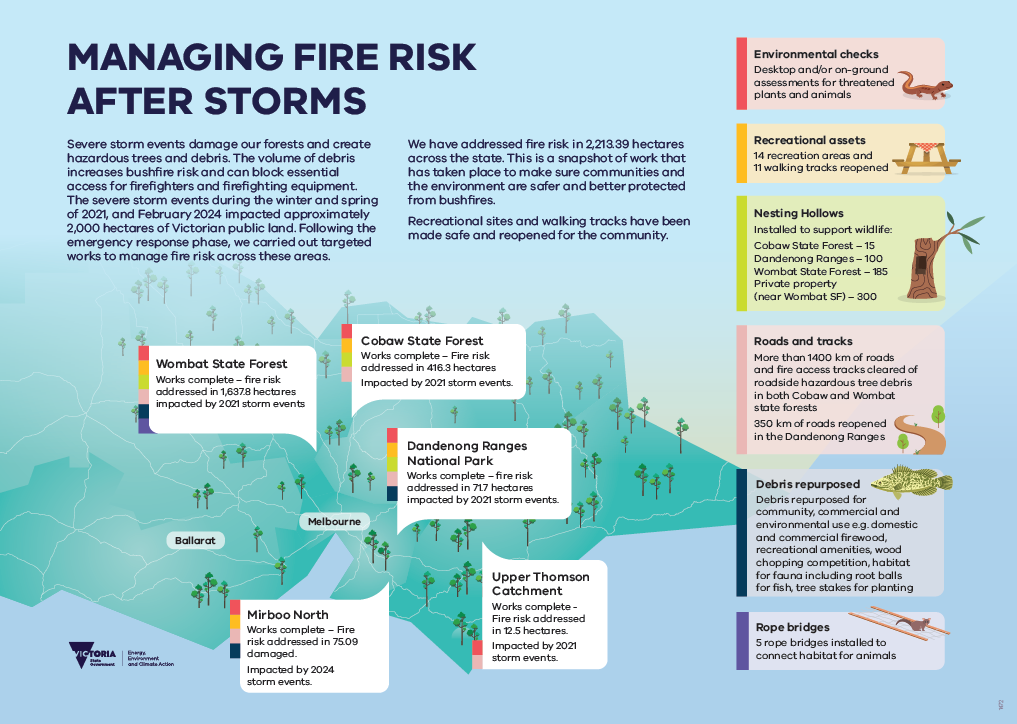
Of the 2,213 storm-impacted hectares, approximately 323 hectares (14.6%) were mechanically treated, while 1,890 (85.4%) had no mechanical intervention .
Removed debris has gone to the best use in the local circumstances.
What we have done under the program
Works are complete in:
- Cobaw State Forest
- Upper Thomson Catchment
- Mirboo North
- Wombat State Forest
- Dandenong Ranges and catchments
What is a hazardous tree?
Falling trees and branches are a significant safety risk to firefighters, staff and the community travelling through or working in affected areas.
A hazardous tree typically has one or more of the following characteristics:
- dead or decaying tree or major branches
- suspected loose or broken branches
- significant lean with recent cause or indicators of failure
- evidence of lengthwise cracking
- evidence of roots lifting, or an undercut or disturbed root system
- other indicators of serious weakness based on local knowledge and conditions
- Hazardous tree removal factsheet (PDF, 399.7 KB)
- Hazardous tree removal factsheet - accessible (DOCX, 2.4 MB)
Environmental values
When FFMVic needs to remove debris to reduce bushfire risk, we look to minimise impact on environmental and other values.
We take care to plan a program that meets our responsibilities to manage the risk of bushfire to communities and the environment.
Because each part of the forest is different, we will consider the best option for each site.
We carry out planning for individual sites. This includes:
- defining the areas that need to be treated for fire risk within each site
- talking to stakeholders
- undertaking desktop assessments and field checks for biodiversity values
- defining exclusion zones or buffers to protect values.
Buffers are areas where works might be excluded or modified to protect a particular value, for example:
- a waterway
- a threatened plant
- habitat for a threatened animal.
Protections can include:
- excluding sensitive areas from works
- tree root protections
- minimising soil disturbance
- treating invasive weeds
- identifying habitat trees of possum species
- limiting removal of standing trees.
We then decide the most suitable treatment option – or options – at each site. These include:
- removing all debris, for example on tracks and roads
- removing some debris, but leaving some debris for habitat
- putting a low-intensity planned burn through the site
- removing hazards to create safe access for firefighters
- planting tube stock or sowing seed.
Standing trees will only be removed where they have been assessed as hazardous and are a risk to safety.
Where appropriate, fallen trees are left for wildlife habitat. They are an important component of a healthy forest.
We aim to retain trees with hollows, which are commonly used as habitat for a range of species.
Bushfire risk
We will always have bushfires in Victoria – it is one of the most bushfire prone regions in the world.
FFMVic's role is to protect life, property and the environment from bushfires on public land.
We remove storm debris where it is a fire risk, and prioritise locations based on risk levels.
Bushfire risk is posed by drying finer debris as well as fallen trees and branches. Large volumes of debris can make it harder and unsafe for firefighters and the public to access areas.
We treat finer debris as a priority through planned burns and other fuel management activities. We remove the large logs created by fallen trees, as these can generate significant radiant heat and block firefighter access during bushfires.
To effectively manage our bushfire risk, we employ several strategies:
- take every opportunity to manage our bushfire risk all year round
- use a range of different tools and methods to get it done effectively with less risk.
We reduce bushfire risk by:
- undertaking planned burning and mechanical fuel management works such as clearing, mowing, and slashing
- constructing and maintaining
- fuel breaks and maintaining fire infrastructure, such as fire dams.
Our year-round strategic fuel management approach gives our firefighters a better chance of controlling fires when they do occur – reducing impacts on people, property and the environment.
Page last updated: 03/07/26