Fire summary
- Location: Otways region near Gellibrand, Kawarren and Carlisle River
- Ignition: Lightning strikes on Friday 9 January (first report at 20:54 from DEECA patrol flight)
- Area burned: About 11,000 hectares
- Duration: Multi-week fire with repeated directional shifts
- Structures lost: At least 16 near Gellibrand
- Terrain: Wet forest, lowland forest, heathy woodland, steep gullies and limited access
Fire behaviour
- Rapid upslope runs
- Heavy spotting driven by stringybark fuels
- Long-range ember attack
- Significant escalation after a strong wind change
Resources
- Approximately 300–400 firefighters (FFMVic and CFA)
- Fixed-wing aircraft, helicopters and reconnaissance flights
- Dozers, graders and heavy machinery
- Aerial monitoring, retardant lines and hand-built control lines
Overview
At least 11 bushfires were ignited by lightning in the Otway District on the evening of Friday 9 January 2026. These ignitions encompassed public and private land to the west of Gellibrand, Kawarren and Carlisle River communities. Response efforts were led by Forest Fire Management Victoria (FFMVic), with support from Country Fire Authority (CFA) and partner agencies.
While many ignitions were suppressed overnight, on Saturday 10 January, 2 fires spread rapidly under strong south-westerly winds. In long-unburnt forest areas, fire behaviour was characterised by high intensity fire and mass short range spotting. However, a combination of recent planned burns to the north-east of the fires lowered fire intensity, reduced ember generation and improved suppression opportunities for firefighters.
For example, between 10 and 11 January, during the Carlisle River – Pipeline Road fire, fuel treatments completed in 2021 and 2022 provided critical advantages for suppression efforts, and helped protect nearby communities.
Under winds up to 50 km h-1, extreme fire behaviour meant that bushfire was likely to impact private assets to the north of Timberjack Track. However, when the bushfire interacted with fuel treated areas, crews on the ground reported that fire behaviour moderated, with lower flame heights and reduced spotting. Reduced fire behaviour meant that ground crews were able shift from defensive asset protection in the private land to proactive containment of the fire within the forest area.
On 23 January, under extreme fire danger conditions, the bushfire took a run toward the Gellibrand township that resulted in the loss of at least 16 structures. Crews on the ground in Gellibrand and aerial suppression aircraft reported that fuel‑reduced areas to the west of Gellibrand slowed the fire. This provided critical time for operational staff to prepare private properties for ember attack and implement back‑burning containment strategies.
These conditions reinforced the importance of a strategic, connected network of fuel-reduced areas to support suppression across the steep and densely vegetated Otway landscape to reduce the risk to private assets, critical infrastructure and natural values.
Without these prevention measures and preparatory activities, firefighters on the fireground report that containment would have been much more difficult and less safe for firefighting personnel. Although we can’t put a number on it at this early stage, on-ground firefighters report that without the network of fuel treatments across the landscape, private asset losses, and impacts to forest values, would have been much higher.
“Fuel management doesn’t stop bushfires starting. What it does do is change the way bushfires grow – giving firefighters opportunities to safely and effectively protect communities, landscapes and critical infrastructure.”
Seasonal conditions and risk environment
The Carlisle River bushfires occurred at the end of a multi-year drought in the region. According to the Bureau of Meteorology, deep soil moisture was in the lowest 10% on record, indicating extremely dry fuels and drought stress in vegetation.
Before the fires ignited, the following conditions were present:
- a statewide heatwave from 8 to 9 January
- catastrophic fire danger in the South West Fire Weather District on 9 January
- forecasts of widespread dry lightning
- at least 11 fire ignitions in the Otway District on the evening of 9 January.
Key factors shaping the fire environment included:
- multiple lightning bands on 9 January, with the third igniting fires across Lardners Track, Kennedys Creek and the Carlisle River pipeline corridor
- strong wind changes with 50–70 km/h gusts, expanding the fire footprint to over 11,000 hectares over three weeks
- steep, forested valleys creating a high-risk public–private interface.
These conditions reinforced the importance of a strategic, connected network of fuel-reduced areas to support suppression across the steep and densely vegetated Otways landscape.
Planned burns in the Otways
Recent planned burns and winter heath burns around Carlisle River, Gellibrand, and Tomahawk Creek area played a significant role in moderating fire behaviour in January 2026.
Tomahawk Creek
The Tomahawk Creek–Gordons Track planned burn (2021) and Tomahawk Creek–Timberjack Track planned burn (2022) both successfully reduced fuel loads across most of their treatment areas. This meant the forest within these burns carried much less flammable material compared with long‑unburnt areas nearby.
As the bushfire reached the treated areas, crews observed clear changes:
- spot fires landing inside the Timberjack Track burn were slow to develop, and some burned out naturally
- where spot fires joined, flame heights were lower, allowing machinery to safely conduct direct attack
- the overall rate of spread decreased, and fire severity was lower.
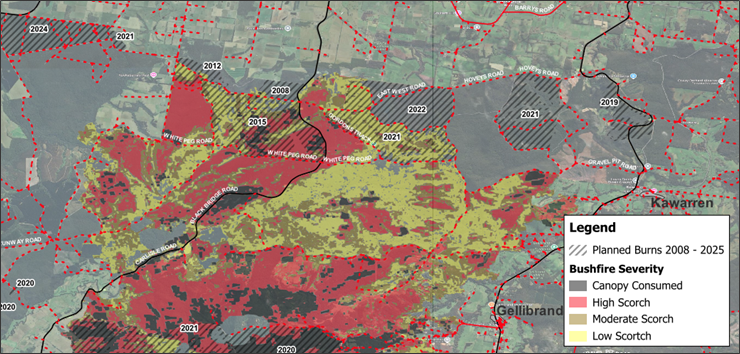
Post fire mapping shows that untreated areas south of Gordons Track experienced high canopy scorch or full canopy burn, while areas inside the planned burns mainly showed understorey burn and low canopy scorch. These treatments helped slow the fire’s northward spread toward Irrewillipe East and Barongarook West.
Kennedys Creek – King's Track
The Carlisle River – Pipeline Road South and Carlisle River – Larsons Road planned burns were completed in early 2021. These burns reduced overall fuel hazard across much of the treatment area. By 2026, bark hazard had increased to moderate–high, and near surface fuels were moderate to very high , but the treated areas still carried significantly less fuel than surrounding long unburnt forest.
On 9 January, spot fires that landed inside the Larsons Road burn self extinguished, even though the fire remained intense at the burn edge.
On 10 January, the Kennedys Creek – Kings Track fire reached both planned burns. Observations from the Air Attack Supervisor and incident controllers showed:
- reduced fire intensity, shifting from crown fire to surface fire
- decreased flame heights, spotting and rates of spread
- much lower fire severity on the treated side, with patchier burn patterns and less canopy consumption visible in the image.
Even though the fire still moved across the treated area, the change in behaviour was significant.
Effects of areas where planned burns happened
The Carlisle River landscape includes some of the Otways' most iconic environments, including wet eucalypt forests, heathy woodlands, steep gullies and creek systems, for example Kennedys Creek, Gellibrand River, Gum Gully Creek, forested rural landscapes and high-value ecological areas home to several important flora and fauna species.
At the time of suppression, planned burn treatments provided:
- areas of reduced bark hazard, lowering spotting potential
- reduced surface, near-surface and elevated fuels, resulting in longer build-up times, lower flame heights and reduced rates of spread
- anchors for indirect strategies, such as backburning, when direct attack was not possible in steep terrain
- improved access and egress routes for crews via prepared roads
- reduced potential for convective fire development.
The fire severity map (above right) highlights the contrast of fire behaviour in the Carlisle River–Pipeline Road bushfire; darker colours show more severe impacts in untreated forest, while crosshatched areas show planned burn areas (including year of burn).
Post-fire, these treatment areas are likely to provide areas of patchier, lower-severity mosaics (especially winter burns), with diverse vegetation structure.
When the fire reached fuel-reduced areas:
- spread slowed substantially
- flame height dropped from 10–20 metres to 2–3 metres
- spotting decreased
- winter burned areas resulted in some vegetation retention
- crews could undertake backburning and direct attack
- control lines were held more consistently than in untreated forest.
Outcomes
The Carlisle River bushfire provided clear evidence that fuel management treatments:
- reduced fire intensity and spotting
- improved containment success under severe conditions
- increased firefighter safety
- enabled proactive rather than defensive suppression
- reduced community impact
- demonstrated multi‑year effectiveness (burns 6–7 years old still providing benefit)
- supported ecological resilience through lower-severity fire behaviour.
Page last updated: 23/05/26